If you’ve ever hesitated before pulling up your own credit score app, half-worried that looking at the number might somehow make it worse, you’ve basically already asked the question this post answers: does checking your credit score lower it? You’re not imagining a real risk out of nowhere — you’re just applying a rule that’s true for one kind of check and mistakenly applying it to another.
The Short Answer: No, Checking Your Own Score Is Safe
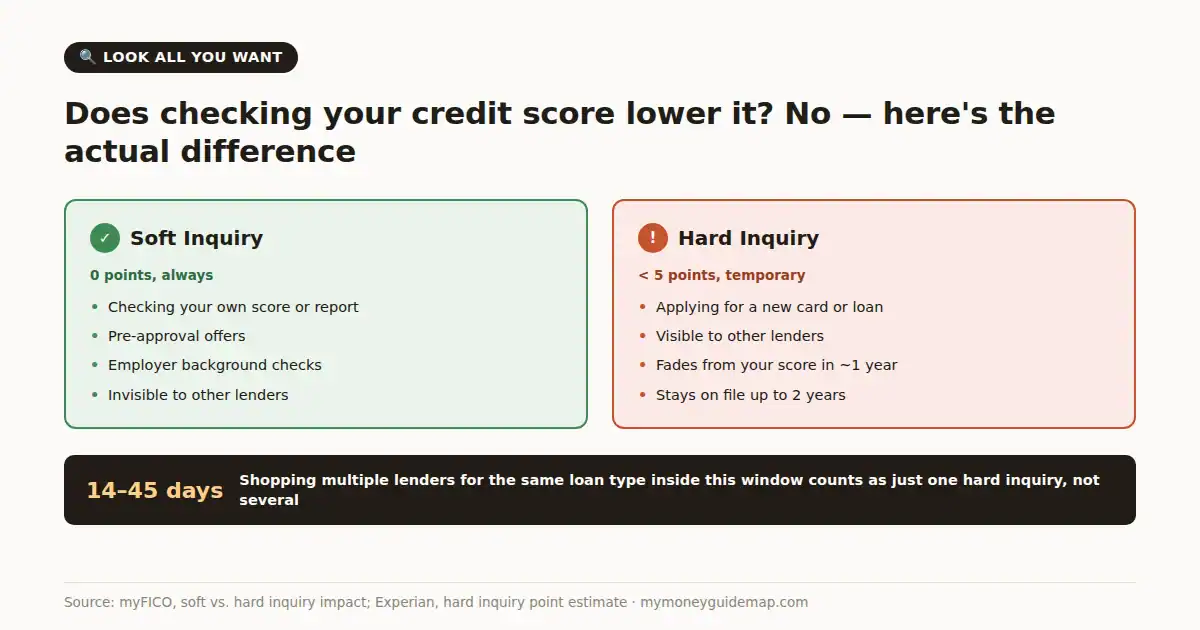
To answer “does checking your credit score lower it” directly: checking your own credit score or credit report counts as a soft inquiry, and myFICO is direct about it: “checking your credit score (via soft inquiry) will not hurt your score.” You can look as often as you want — daily, weekly, through your bank’s app or a free service — without it costing you a single point. The confusion almost always comes from mixing this up with a different kind of check entirely.
Why People Ask “Does Checking Your Credit Score Lower It” in the First Place
A soft inquiry happens when you check your own score, or when a company checks it for something like a pre-approval offer or a background screening. It’s invisible to other lenders and has zero effect on your score. A hard inquiry is different — it happens when you actually apply for credit, like a new card, an auto loan, or a mortgage, and it’s visible on your report for other lenders to see.
Hard inquiries are the ones that can shave a small amount off your score, and even then, the damage is usually modest. Experian confirms the same rough figure: each new hard inquiry typically costs less than five points, though the exact hit depends on your overall credit profile — someone with a thin file tends to feel it more than someone with years of established accounts and a long credit history.
Why Rate Shopping Doesn’t Punish You the Way You’d Expect
There’s a specific worry that stops people from comparing loan offers: applying to multiple lenders for a mortgage or auto loan feels like it should rack up a hard inquiry every time, tanking your score in the process. Scoring models actually account for this. Multiple hard inquiries of the same type — say, several mortgage lenders — made within a window of roughly 14 to 45 days get bundled into a single inquiry for scoring purposes, rather than stacking penalties for every application. The practical upshot is that shopping around for the best rate on a single big purchase is treated far more gently than it feels like it should be.
How Long a Hard Inquiry Actually Sticks Around
A hard inquiry stays visible on your credit report for up to two years, but its effect on your actual score fades much faster — typically within about a year, and the biggest drop happens right after the inquiry, tapering off from there. This is part of why one hard inquiry for a new credit card isn’t something to lose sleep over, while opening five new accounts in a single month is a different story entirely.
What This Means for Actually Monitoring Your Credit
Given that checking your own score costs nothing, there’s not much reason to avoid it, and plenty of reason to do it regularly — it’s the only way to catch errors on your report before they quietly cost you a better rate, and it’s one of the simplest ways to track whether whatever you’re doing to manage your credit utilization is actually moving the number. The habit worth building isn’t caution about looking — it’s caution about how many new accounts you actually apply for in a short stretch of time.
The Actual Takeaway
So, does checking your credit score lower it? No — it’s a soft inquiry and never lowers it, no matter how often you do it. What actually costs you points, modestly and temporarily, is applying for new credit through a hard inquiry — and even that damage is usually small, grouped generously when you’re rate shopping, and fades within about a year. Check your score as often as you want; just be more deliberate about how often you actually apply for something new.