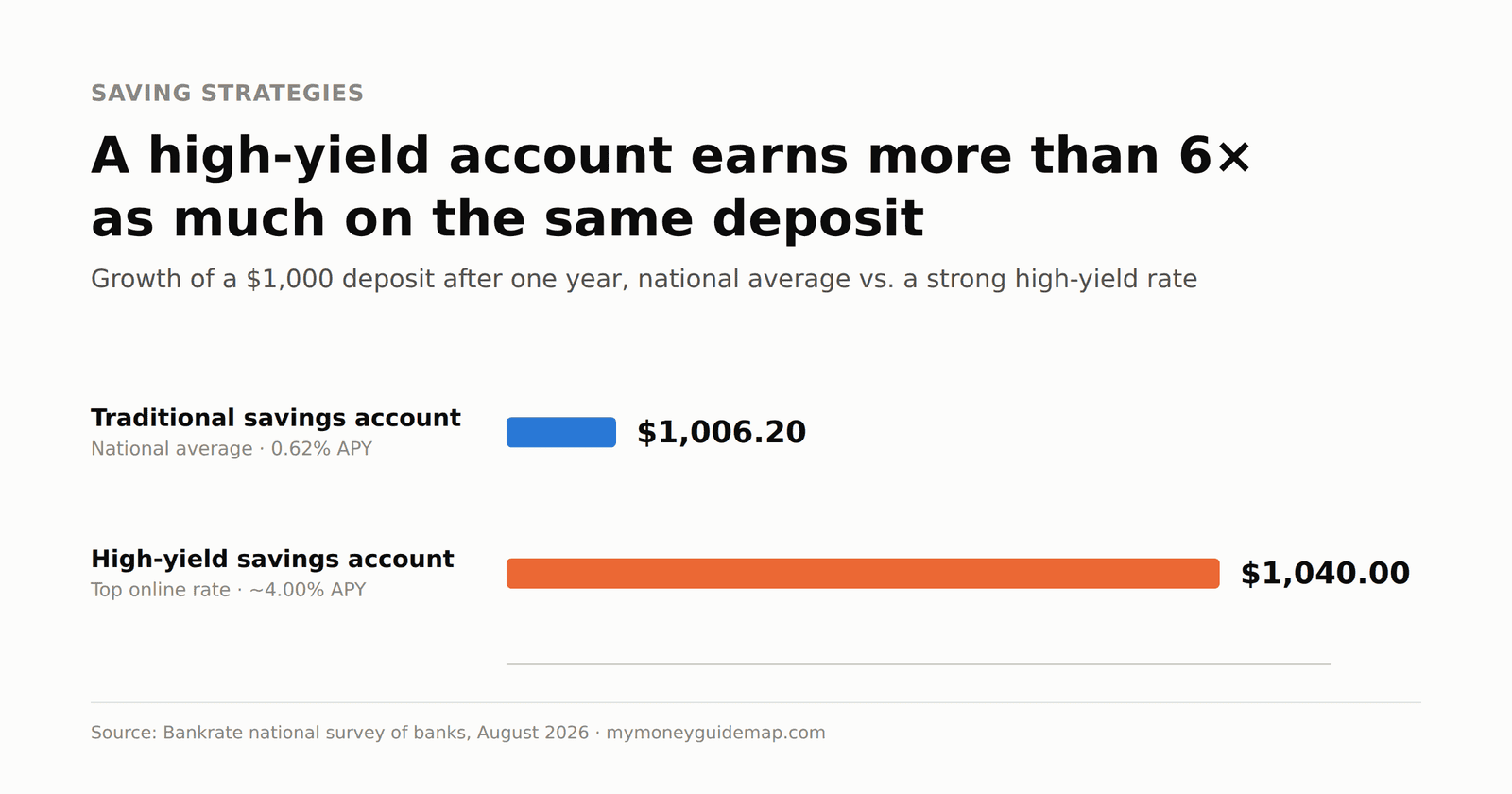
If you’ve ever left your savings sitting in a regular checking or savings account, you’ve probably wondered why your balance barely grows even after months of not touching it. That’s not a coincidence — according to Bankrate’s national survey of banks, the average traditional savings account pays just 0.62% APY, while the strongest high-yield accounts are currently paying around 4%. High-yield savings accounts were built to close exactly that gap, and understanding how they work is one of the simplest, lowest-risk upgrades you can make to your personal finances.
What a High-Yield Savings Account Actually Is
A high-yield savings account (often shortened to HYSA) is a savings account that pays a significantly higher interest rate than a standard savings account at a traditional bank. They’re most commonly offered by online banks and credit unions, which tend to have lower overhead costs than brick-and-mortar banks and pass some of those savings on to customers in the form of better rates.
The core function is identical to any savings account you’ve ever had: you deposit money, the bank holds it safely, and you earn interest over time. The only real difference is how much interest you earn — and as the numbers above show, that difference isn’t small.
How It’s Different From the Account You Probably Already Have
On the surface, a high-yield savings account looks and works almost identically to the savings account at your local bank. You can still deposit, withdraw, and transfer money, and in most cases it’s still insured the same way. The differences tend to show up in a few specific places:
The rate itself is the headline difference — many times higher than what a standard account offers. Where it’s offered matters too: online-only banks and credit unions are the most common source of competitive rates, since they don’t carry the cost of physical branch networks. That trade-off cuts both ways, though — you may not get in-person branch access, which matters if you prefer handling banking face-to-face. Some accounts also come with fewer extras, like no debit card or check-writing.
How the Interest Actually Works
Interest on a savings account is expressed as an APY, which reflects how much your balance would grow over a year if the rate stayed the same and interest compounded — meaning you earn interest on your interest, not just your original deposit.
Two things matter most here: the rate itself, and how often that interest compounds. Many high-yield accounts compound daily and pay out monthly, which adds up faster than accounts that compound less frequently.
To put the gap in perspective: at the national average of 0.62% APY, $1,000 would grow to about $1,006.20 after a year. At a strong high-yield rate closer to 4%, that same $1,000 would earn roughly six times as much. Because rates are variable and can change at any time based on broader economic conditions, it’s worth checking the current APY directly on a bank’s website rather than relying on a number you saw somewhere else — including this article.
Where the Trade-offs Show Up
The upside is real: your cash works meaningfully harder just sitting there, and as long as the account is held at an FDIC-insured bank or NCUA-insured credit union within coverage limits, your principal is protected the same way it would be in a traditional account. Most online high-yield accounts can be opened in a few minutes, often with no minimum deposit, and your money generally isn’t locked up the way it would be in a CD.
The catch is that none of this is fixed. Rates are variable, and a bank can lower the APY at any time — there’s no guarantee the number you signed up for sticks around. If you value walking into a branch to talk to a person, an online-only bank may not be the right fit. And even a strong APY here is still lower than the long-term average return of other investment vehicles, so this isn’t a substitute for retirement or long-term investing — it’s a place to park cash safely, not a way to grow wealth. Transfers between an online savings account and your everyday checking account can also take a day or two rather than being instant.
Who This Is Actually For
A high-yield savings account tends to make the most sense for money you want to keep safe and accessible but don’t need to touch every day — the emergency fund we talked about when covering zero-based budgeting, savings for a short-term goal like a trip or a car, or cash you’re setting aside before a bigger purchase.
It’s generally not the right tool for long-term goals like retirement, where other account types are built to help your money grow over decades. It also may not suit someone who relies heavily on in-person banking or needs frequent same-day transfers.
What to Check Before You Open One
A few details are worth comparing across banks before you choose one, rather than picking based on the advertised rate alone:
- Insurance coverage — confirm the bank is FDIC-insured (or NCUA-insured for credit unions), and understand the coverage limits
- Minimum balance requirements — some accounts require a minimum balance to earn the advertised rate or avoid fees
- Monthly fees — many high-yield accounts have none, but it’s worth checking the fine print
- Withdrawal limits — ask whether there’s a cap on withdrawals or transfers per month
- Transfer speed — especially relevant if you might need funds quickly in an emergency
The Mistakes Worth Avoiding
The most common one is chasing the highest advertised rate without reading the fine print — a great rate isn’t useful if it comes with a minimum balance you can’t maintain. A close second is treating the account like an investment vehicle rather than what it actually is: a safe place to park cash. It’s also easy to forget that the rate you signed up at isn’t guaranteed to last, so it’s worth checking every so often whether your account is still competitive. And it’s worth thinking through how much cash you genuinely need accessible versus how much could be working toward other goals.
The Takeaway
A high-yield savings account is one of the simplest ways to make idle cash work harder without taking on extra risk. It won’t replace investing for long-term goals, but for money you want to keep safe and accessible — like an emergency fund — it’s usually a far better home than a traditional account paying next to nothing. As with anything financial, take a few minutes to compare the details beyond the advertised rate before you open one.
2 thoughts on “High-Yield Savings Accounts Explained: What Beginners Need to Know”