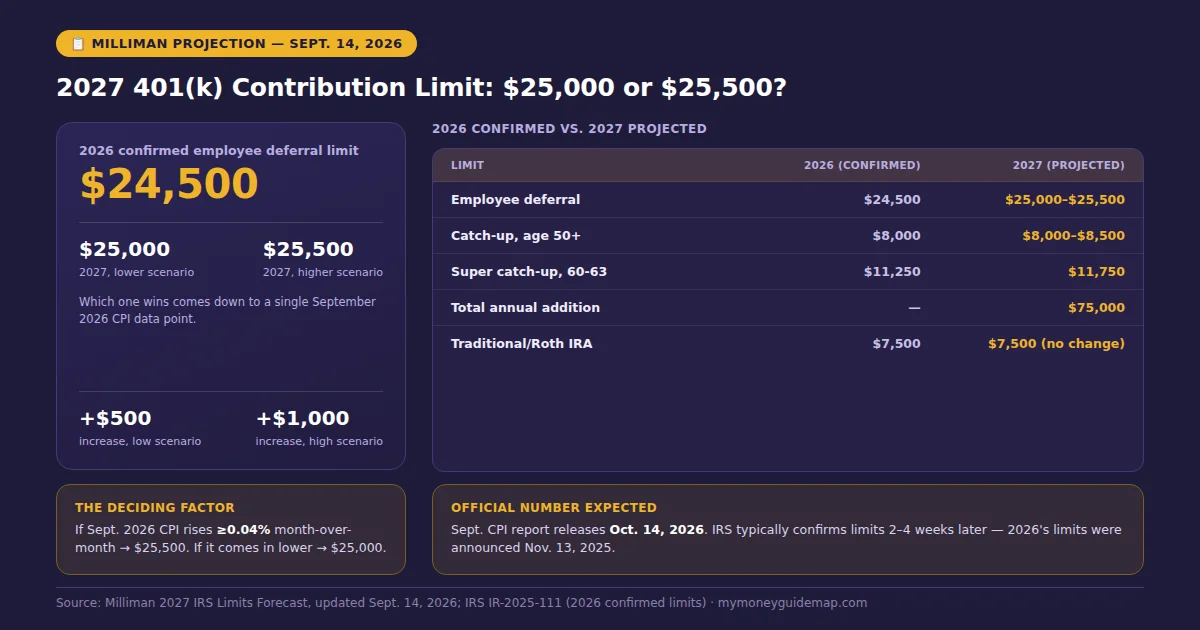
2027 401k contribution limit projections just got a fresh update, and it landed only days ago: Milliman, the actuarial firm whose forecasts have closely tracked the IRS’s actual announcements in past years, updated its estimate on September 14, 2026 using real Consumer Price Index data through August. Their call is that the employee deferral limit rises to $25,500, though a slower September inflation reading could leave it at $25,000 instead — a gap that comes down to a single, very specific data point, and one more month of waiting before it’s locked in.
What Is the 2027 401k Contribution Limit Projected to Be?
Milliman’s primary scenario has the 2027 401k contribution limit at $25,500, a $1,000 increase from 2026’s confirmed $24,500. That number holds only if September 2026’s CPI reading comes in at 0.04% or higher month-over-month. If it comes in below that threshold, the projection drops to $25,000 instead — still a real increase, just half the size. The same split shows up in the age 50+ catch-up contribution: $8,500 under the higher scenario, or unchanged at $8,000 under the lower one. The special “super catch-up” for savers aged 60-63 is projected at $11,750 either way, up from $11,250 in 2026, since that figure isn’t tied to the same CPI trigger. It’s a narrow, almost technical difference on paper, but it’s the difference between $500 and $1,000 more room to save pretax next year.
How the 2027 Projection Compares to 2026’s Confirmed Numbers
Seeing both years side by side makes the stakes of that single CPI data point clearer:
| Limit | 2026 (confirmed) | 2027 (projected) |
|---|---|---|
| Employee deferral | $24,500 | $25,000–$25,500 |
| Catch-up, age 50+ | $8,000 | $8,000–$8,500 |
| Super catch-up, age 60-63 | $11,250 | $11,750 |
| Total annual addition (DC plans) | — | $75,000 |
| Traditional/Roth IRA | $7,500 | $7,500 (no change expected) |
The 2026 figures were confirmed by the IRS in its official November 2025 announcement, so those numbers are locked in; everything in the 2027 column is still Milliman’s best estimate, not law.
Why the Official 2027 401k Contribution Limit Isn’t Out Yet
The IRS can’t finalize next year’s limit until it has a full picture of this year’s inflation, and that data simply isn’t complete yet. The Bureau of Labor Statistics releases its September CPI report on October 14, 2026, and the IRS typically follows with its official contribution-limit announcement a few weeks later — 2026’s numbers were announced on November 13, 2025, so a similar late-October-to-mid-November window is the reasonable expectation again this year. Until then, Milliman’s projection is the most current, data-backed estimate available, updated as new CPI readings come in rather than frozen from a single forecast made months ago. It’s also worth remembering that a projection is exactly that: the IRS has occasionally rounded differently than outside forecasters expected, so treat both the $25,000 and $25,500 figures as a very well-informed range rather than a guarantee.
What This Means for Your 2027 Paycheck Planning
There’s nothing to act on immediately — the number isn’t official, and payroll systems won’t reflect a 2027 limit until the IRS confirms it. But it’s worth putting on the radar if you’re already maxing out your 401(k) or getting close to it: a $500 or $1,000 jump in allowed contributions means a slightly higher percentage-of-pay election come January if you want to hit the new ceiling, and workers turning 50 or landing in the 60-63 window should note that the catch-up limits move by different amounts depending on which scenario holds. Anyone who sets their contribution rate as a flat percentage rather than a dollar amount will likely see their own contribution rise automatically alongside any raise, but it’s still worth double-checking the math in January rather than assuming last year’s percentage still maxes things out under a higher ceiling. For a full breakdown of this year’s confirmed numbers and how they interact with employer matching, the 401(k) Contribution Limits 2026 guide covers the current, locked-in figures in detail.
Whichever scenario plays out, the 2027 401k contribution limit is headed up, not down — the only real question left is whether it’s a $500 or a $1,000 increase, and that answer arrives with one more month of inflation data.