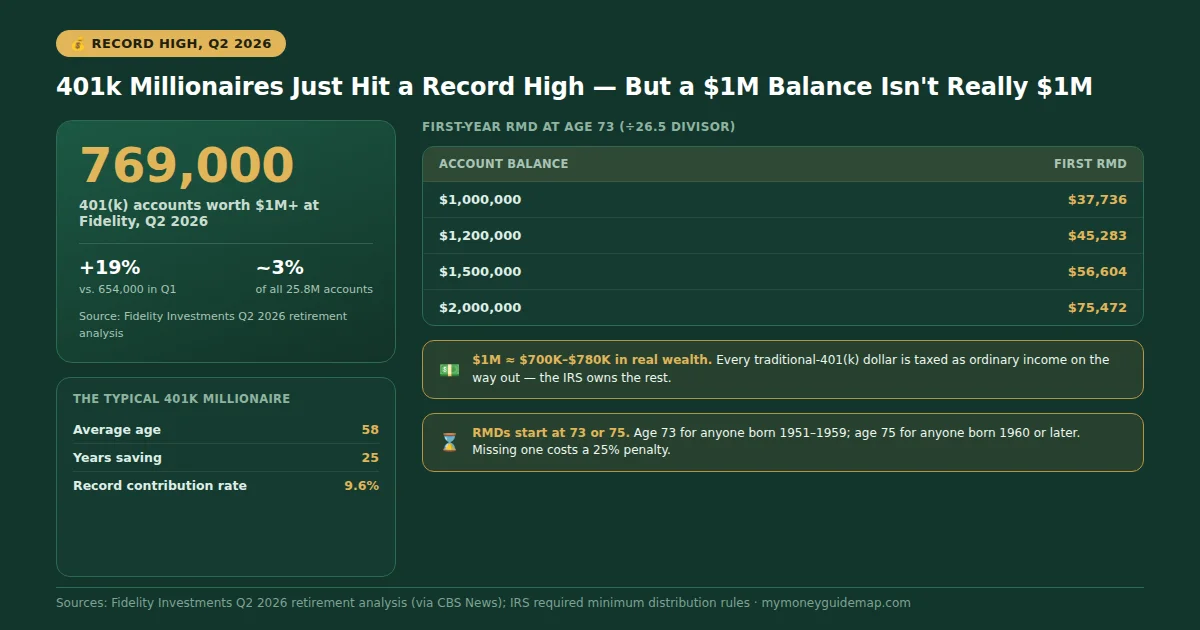
401k millionaires just hit a record high — Fidelity counted 769,000 accounts worth $1 million or more as of June 30, 2026, up 19% from the previous quarter alone. That headline sounds like pure good news, but a $1 million traditional 401(k) balance isn’t actually worth $1 million once the IRS’s eventual cut is factored in.
How Fidelity Counted a Record 769,000 401k Millionaires
The jump from 654,000 millionaire accounts in Q1 to 769,000 in Q2 2026 tracks a strong market: the S&P 500 gained 15% in the quarter alone, 20% over the trailing 12 months, and roughly 71% over the past five years. Savers kept doing their part too — the average contribution rate hit a record 9.6% in Q2, even as workers reported feeling behind. Fidelity’s own data shows 72% of workers believe they’re lagging on retirement savings and nearly 70% doubt they’ll retire comfortably, even as the number of seven-figure accounts keeps climbing. Even at a record high, 401k millionaires are still rare: 769,000 accounts works out to only about 3% of Fidelity’s 25.8 million total 401(k) accounts. The typical 401k millionaire is 58 years old with 25 years of consistent saving behind them — not a lucky timing story, but a long, boring habit that finally compounded into a big number.
Why a $1 Million 401(k) Isn’t Really $1 Million
Here’s the catch that headlines about 401k millionaires tend to skip: a traditional 401(k) is funded with pre-tax dollars, so every dollar that eventually comes out gets taxed as ordinary income. That means a $1 million balance typically represents somewhere between $700,000 and $780,000 in real, spendable wealth — the IRS effectively owns a silent minority stake in the account that gets collected on the way out, not on the way in.
What Happens When RMDs Kick In at 73 or 75
That tax bill isn’t optional, and it isn’t indefinitely deferrable either. Required minimum distributions (RMDs) start at age 73 for anyone born between 1951 and 1959, and at 75 for anyone born in 1960 or later. Missing one is expensive: the penalty is 25% of the shortfall, cut to 10% if it’s corrected promptly. The size of that first mandatory withdrawal scales directly with the balance, using an IRS life-expectancy divisor of 26.5 at age 73:
| Account Balance at 73 | First-Year RMD (÷26.5) |
| $1,000,000 | $37,736 |
| $1,200,000 | $45,283 |
| $1,500,000 | $56,604 |
| $2,000,000 | $75,472 |
A $1.2 million balance, for example, forces out roughly $45,000 in the very first year — and that single withdrawal can trigger three tax consequences at once: it can push the account owner into a higher federal bracket (commonly 22%), it can make up to 85% of Social Security benefits taxable instead of a smaller share, and it can raise Medicare Part B and D premiums through IRMAA surcharges tied to reported income two years earlier.
Is There a Way to Reduce the Tax Bill Before RMDs Start?
The good news is that the gap between a typical retirement age and the RMD trigger age isn’t dead time — it’s roughly a 12 to 22 year window where taxable income is often lower than during peak earning years, and Roth conversions can be done at comparatively favorable rates. Converting a portion of a traditional 401(k) or IRA balance to a Roth account each year during that window means paying tax on that chunk now, at today’s bracket, so it never counts toward a future RMD and grows tax-free from that point on. It’s a deliberate trade: a smaller, known tax bill today in exchange for a smaller, less surprising one for the rest of retirement.
None of this means joining the ranks of 401k millionaires is a hollow achievement — it still represents two or three decades of consistent saving and a real head start most workers won’t have. But treating the account balance itself as the finish line, rather than the after-tax number underneath it, is exactly what leaves people caught off guard by their first RMD. The more useful way to read a number like $1 million in a 401(k) is as a gross figure with a known future tax bill attached — one that a few years of Roth conversions, planned before age 73, can shrink considerably. Whether an account is worth $200,000 or well past seven figures, the underlying math is the same: pre-tax growth is a loan from the IRS, and the terms of repayment are set by RMD rules, not by how the balance got there.