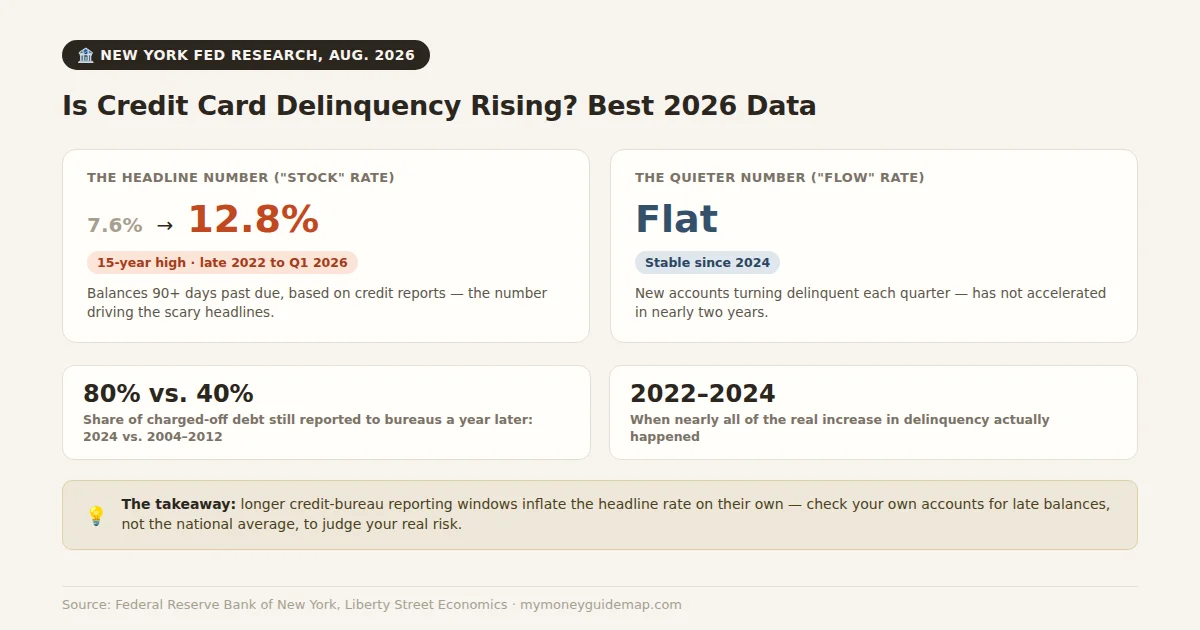
Is credit card delinquency rising, or is a scary-sounding headline number telling only part of the story? According to the Federal Reserve Bank of New York, 12.8% of credit card balances were 90 or more days past due as of the first quarter of 2026, up sharply from 7.6% back in late 2022 — a level not seen in roughly 15 years. That number alone sounds like a full-blown crisis in the making.
Is Credit Card Delinquency Rising, or Is the Reporting Just Different Now?
Look closer at that same research, though, and the picture gets more complicated. The Fed’s own researchers, writing on the New York Fed’s Liberty Street Economics blog, point out that this “stock” measure — the one built from credit reports — has been rising partly because lenders are reporting charged-off debt to credit bureaus for far longer than they used to. Back in the 2004–2012 period, only about 40% of charged-off accounts were still being reported to bureaus a year later; by 2024, that share had climbed to roughly 80%.
That reporting shift alone inflates the stock delinquency rate without a single additional household actually falling behind. It’s the financial equivalent of a longer paper trail, not necessarily more distress. This is exactly why is credit card delinquency rising turns out to be a harder question than it first looks — the same underlying group of struggling borrowers can produce a rising “stock” number for years just because their old, already-defaulted debt keeps showing up on more credit reports for longer than it used to.
To be clear, this isn’t the researchers claiming nothing is wrong. Delinquency did climb meaningfully from 2022 through 2024, and it remains well above where it sat before the pandemic. The point is narrower: the sharpest part of that increase already happened, and the newer headlines repeating a “15-year high” are mostly describing the lingering effects of that earlier climb, filtered through longer reporting windows, rather than a fresh acceleration happening right now.
What the Less-Flashy Numbers Actually Show
Is credit card delinquency rising in a way that should actually worry the average cardholder? If the answer hinges on one number, it’s this one. The more telling measure, according to the same researchers, is the “flow” rate — how many accounts newly become delinquent each quarter, plus separate data on 30-plus-day-past-due balances still sitting on lenders’ own books. Both of those have stayed “relatively stable for almost two years,” which led the researchers to a strikingly calm conclusion: the pace of credit card delinquency is elevated compared to pre-pandemic years, but it has been largely flat since 2024, not accelerating.
So is credit card delinquency rising in the way the 15-year-high headline implies? Not really — it rose sharply between 2022 and 2024, then leveled off, and the newer data since then reflects an accounting quirk more than a fresh wave of missed payments.
What This Actually Means for Your Own Finances
None of this changes anything if you personally are behind on a credit card payment right now — a household-level “it’s not so bad nationally” statistic offers no comfort to an individual account that’s actually 90 days late, and this reassurance isn’t meant for anyone currently missing payments. For that situation, comparing the debt snowball and debt avalanche methods is the more useful next step than parsing Fed research, since the goal at that point is a concrete payoff order, not a national statistic.
For everyone else, the practical takeaway is to treat headline delinquency statistics with a little skepticism before reacting to them. Is credit card delinquency rising in a way that should change how a typical, current-on-their-payments household budgets? Probably not by much — a national rate climbing doesn’t automatically mean the average cardholder’s risk is climbing at the same pace, and sometimes a scary-looking figure just means the accounting got more thorough rather than more people falling behind.
Checking your own accounts for any balance creeping past 30 or 60 days late will tell you far more about your actual financial health than any nationwide percentage ever could. The Fed’s data is genuinely useful for understanding the broader economy, but it was never designed to answer a question about one specific household’s finances — that answer still has to come from your own statements, not a research blog.