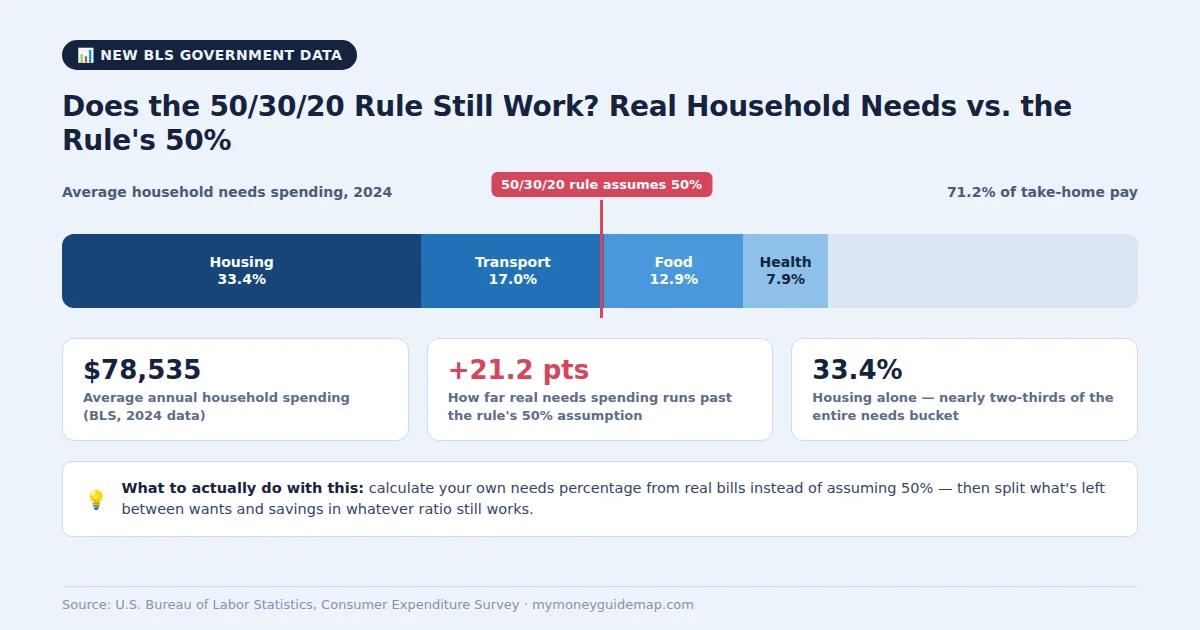
Does the 50/30/20 rule still work, or is it asking something most households can no longer do? The rule splits take-home pay into 50% needs, 30% wants, and 20% savings or debt payoff. New government spending data tells a different story about that first number: according to the Bureau of Labor Statistics’ latest Consumer Expenditure Survey, the average household spent $78,535 in a year, and housing alone ate up 33.4% of that — before a single dollar went toward food, a car payment, or anything else.
Does the 50/30/20 Rule Still Work Once You Add Up Real Costs?
Add up just the categories nobody would call optional — housing at 33.4%, transportation at 17.0%, food at 12.9%, and healthcare at 7.9% — and needs alone come to 71.2% of the average household’s spending. That’s not close to the 50% the rule sets aside; it’s nearly a third higher, and this is before counting things like minimum debt payments or insurance premiums that plenty of people would also call non-negotiable.
Housing is doing most of the damage on its own. At 33.4%, rent or a mortgage payment is already eating more than the entire 50% needs bucket is supposed to cover for everything combined. Does the 50/30/20 rule still work in a household where housing alone takes a third of income? For a lot of people, the honest answer is no — not because they’re managing money badly, but because the rule was never built around today’s housing costs in the first place.
That 33.4% figure is only the average, and plenty of renters have it worse. Harvard’s Joint Center for Housing Studies found that 49% of renter households — about 22.7 million of them — already spend more than 30% of their income on rent and utilities alone, before a single other need on the list gets paid.
So Is the Rule Actually Broken?
Not exactly. The 50/30/20 rule was always a starting template, not a law of budgeting, and the real value in it was never the specific 50/30/20 split — it was the habit of sorting spending into needs, wants, and savings before deciding what to cut. That sorting still works fine. What’s broken is treating 50% as an achievable target for needs when the national average is already running 20 points past it.
A more honest way to use the framework in 2026 is to calculate your own needs percentage first, using real numbers from your last few months of spending, and treat that as the baseline instead of assuming 50%. If needs land at 65% for your household, the choice isn’t to shame yourself into an impossible 50% — it’s to split whatever’s left between wants and savings in a ratio that still leaves room for both, even if that’s closer to 20/15 than 30/20.
Does the 50/30/20 rule still work as a rough gut-check even when the exact percentages don’t fit your budget? Used that way — as a quick flag for whether needs spending has quietly crept higher than it should — it still earns a place in a beginner’s toolkit. The mistake is treating it as a pass-or-fail test instead of a flexible starting point that gets adjusted once real numbers are in front of you.
Where the Original Ratio Still Makes Sense
Does the 50/30/20 rule still work as written for everyone? For households with lower housing costs relative to income — a paid-off mortgage, a lower cost-of-living area, or an income high enough that even a large apartment is a small share of take-home pay — the original 50% ceiling is genuinely realistic, and there’s no reason to abandon it. The rule isn’t wrong for those households; it’s just not universal the way it’s often presented.
Does the 50/30/20 rule still work for your specific budget, though, rather than the average one in a government survey? That’s really the only question worth answering, and it starts with your own needs percentage instead of a national figure. For everyone whose needs run well past 50%, the fix isn’t a different rule so much as a different starting number. Comparing the 50/30/20 rule against zero-based budgeting is worth doing here, since zero-based budgeting skips the percentage assumptions entirely and starts from your actual bills — which is exactly what this year’s spending data suggests most households need to do anyway, at least until their own needs percentage comes down closer to what the rule expects.
1 thought on “Does the 50/30/20 Rule Still Work? Best 2026 Numbers”