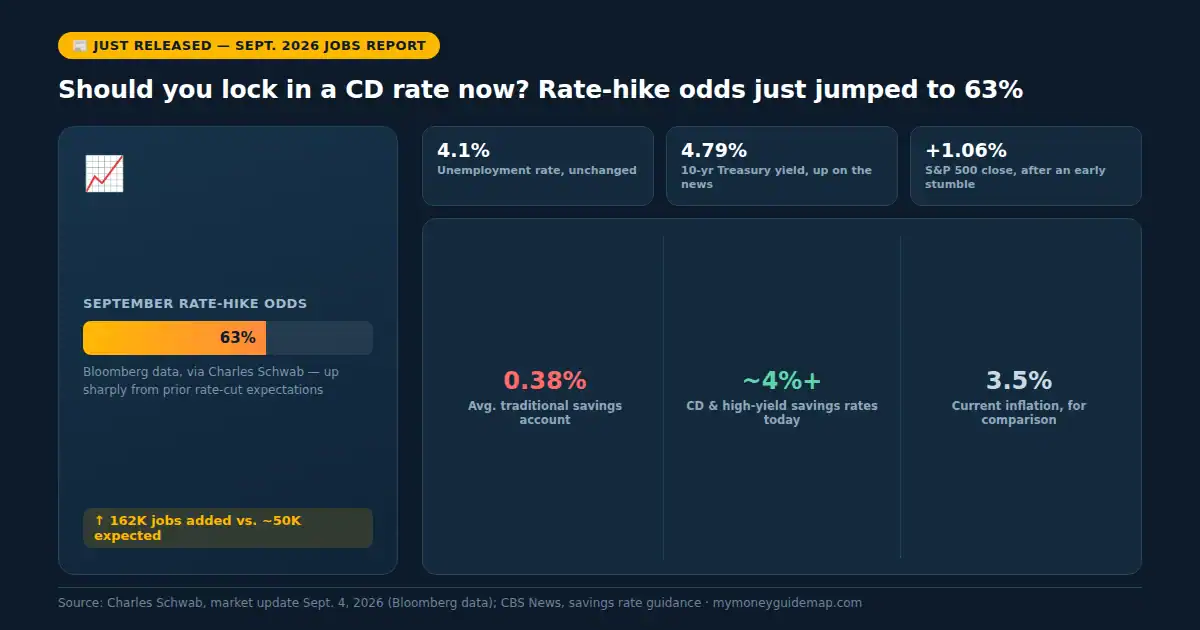
Should you lock in a CD rate now, before it potentially disappears? A jobs report released this week just made that question a lot more urgent. August payrolls came in at 162,000 jobs added, more than triple what economists expected, and the surprise strength pushed the odds of a September rate hike to 63%, according to Bloomberg data cited by Charles Schwab — a sharp reversal from the rate-cut expectations that had been building for months. The 10-year Treasury yield jumped to 4.79% on the news, and the stock market, after an early stumble, closed higher across the board.
Why “Should You Lock In a CD Rate Now” Is Suddenly a Live Question
None of this means a hike is guaranteed — odds are still a coin flip either way — but it does flip the calculus that’s been guiding savings advice all year. The working assumption since spring was that CD and high-yield savings rates were on their way down as the Fed eased. A stronger labor market makes the Fed less likely to cut, and if anything, opens the door to holding rates steady or nudging them up, which is exactly why the question of whether you should lock in a CD rate now stopped being hypothetical this week.
Nothing about today’s rates changes with a single jobs report. What changes is the confidence that they’ll still be here next month.
The Actual Numbers Worth Locking In
A traditional savings account is still paying an average of just 0.38%, which doesn’t come close to keeping up with 3.5% inflation — money sitting there is quietly losing value every month. CDs, by contrast, are running around 4% or higher right now, and high-yield savings and money market accounts are paying rates near or above 4% as well, with the added benefit of staying liquid. The gap between “doing nothing” and moving your cash into either option is currently worth hundreds of dollars a year on even a modest balance.
The case for a CD specifically is that the rate is fixed the moment you open it — a hike or a pause doesn’t touch what you’re already locked into, while a high-yield savings rate can drift down the moment the bank decides to reprice it. Should you lock in a CD rate now rather than waiting? Today’s number is the number you keep, regardless of what the Fed actually does at its next meeting.
A shorter CD term hedges this bet without giving up much. A 6- to 12-month CD at close to today’s rate still captures most of the current yield, and it matures soon enough that you’re not stuck if rates end up climbing further instead of falling — you’d simply reinvest the payout at whatever the new, possibly better, rate turns out to be.
Where a CD Isn’t the Right Move
Should you lock in a CD rate now with your whole cash cushion? Not if any of it is your emergency fund. CDs charge an early-withdrawal penalty, and a surprise expense showing up mid-term turns a good rate into a bad trade. The same caution applies to money you might need for a near-term move, a car repair, or anything without a firm date — that cash belongs somewhere you can reach without a penalty, even if the rate is a touch lower.
For money you’re confident you won’t need for six months to a few years, though, this week’s numbers make a fixed rate look better than it has in a while. Comparing exactly how a CD stacks up against a high-yield savings account is worth doing before picking either one, since the right split between “locked and certain” and “liquid and flexible” depends more on your own timeline than on anything the jobs report changed this week.
So, should you lock in a CD rate now? For the portion of your savings you won’t touch soon, probably yes — and probably sooner than later, since one more strong data point between now and the Fed’s September meeting could push those hike odds even higher, or just as easily fade back the other way. Either way, the rate sitting in front of you today isn’t guaranteed to still be there next month.